
By Shriyadita De
Introduction
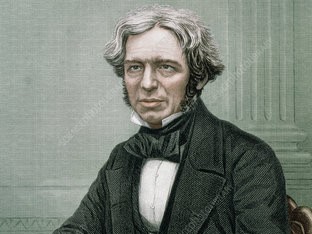
Michael Faraday, an English scientist and pioneer in the field of physics, transformed our understanding of electricity and magnetism. His groundbreaking discoveries laid the foundation for much of modern physics and electrical engineering. Known for his perseverance and grasp of scientific principles, Faraday’s work continues to inspire scientists worldwide.
Early Life and Education
Born on September 22, 1791, in Newington Butts, London, Faraday grew up in a working-class family. His early education was limited, and he began working as an apprentice to a bookbinder at age 14. Fascinated by science, Faraday eagerly read the books that passed through his hands, especially those on physics and chemistry.
His life changed when he attended lectures by the renowned chemist Humphry Davy at the Royal Institution. Faraday impressed Davy with his passion for science and was eventually offered a position as Davy’s laboratory assistant, a role that would allow him to develop his scientific skills and embark on his own research.
Revolutionary Discoveries
Michael Faraday’s discovery of electromagnetic induction in 1831 is his most groundbreaking contribution to science. He found that moving a magnet through a coil of wire generates an electric current, demonstrating that a changing magnetic field could produce electricity. This principle of electromagnetic induction is the basis of electric generators, allowing mechanical energy to be converted into electrical energy, which powers homes, industries, and entire cities.
In the field of electrochemistry, Faraday made significant discoveries as well. He formulated the laws of electrolysis, which quantifies the relationship between electric currents and the chemical reactions they produce. Faraday’s research explained how electric currents cause ions in a solution to move and deposit on electrodes, enabling him to predict the amount of substance altered by electric current. His electrochemical laws became essential in fields, ranging from electroplating and battery technology to medical applications involving ion transport.
The Faraday Cage, another revolutionary discovery, showcased Faraday’s intelligence and creativity in practical applications of his theories. While experimenting with electricity, he observed that an enclosed conductor could block external electric fields, protecting the interior from electrical interference. This principle led to the design of Faraday Cages, which are used today to shield sensitive electronic equipment from external static and electromagnetic fields, as well as to safeguard people and equipment during thunderstorms and electrical discharges.
A Lasting Legacy
Michael Faraday’s contributions to science went beyond his discoveries. His work influenced later physicists, including James Clerk Maxwell, who formalized Faraday’s theories in the equations of electromagnetism. Today, Faraday is remembered as one of the greatest experimental scientists, and his principles remain integral to our understanding of physics and the development of technologies.
Sources:
Michael Faraday | Biography, Inventions, & Facts | Britannica
Electromagnetism – Induction, Faraday, Magnetism | Britannica
Faraday’s laws of electrolysis | Definition, Example, & Facts | Britannica
 BrainBox
Leave a comment